You can like an artwork on a screen and still struggle to imagine it above your sofa. The wall looks large, the sizes are written in millimetres, and the frame in the room photograph may have little to do with what you are ordering.
To choose wall art for a living room, start with a particular wall, decide what kind of subject you would enjoy seeing there, and test the finished size in the actual room. Include the mount and frame in your measurements. You will make a clearer decision with a tape measure and a paper outline than by trying to judge scale from a photograph alone.
Choose the wall before choosing the size
Look around the room from the places where you spend time: the sofa, a favourite chair and the doorway. Decide where an artwork would be easy to see without competing with a television, a busy bookshelf or another piece you already enjoy.
You do not have to use the largest empty wall. A smaller space beside a reading chair can give a work a place of its own. Above a sofa, think about the furniture and the wall together; in a narrow space, pay attention to nearby door frames, switches and curtains.
Measure the usable area, not just the full wall. Write down its width and height, and note anything that limits the position. Leave room to breathe around the piece. The amount of space that feels right will depend on the room and the work, rather than a single decorating ratio.
Understand the difference between paper size and framed size
Ordered Lines artworks are available in A4, A3, A2 and A1. These describe the paper sheet. The drawn composition sits within that sheet and need not fill it edge to edge. Neither measurement tells you the outside size once a separate mount and frame are added. Plan with the full sheet first, then ask your framer for the finished footprint.
| Size | Short side | Long side |
|---|---|---|
| A4 | 21 cm | 29.7 cm |
| A3 | 29.7 cm | 42 cm |
| A2 | 42 cm | 59.4 cm |
| A1 | 59.4 cm | 84.1 cm |
For a landscape work, the long side runs horizontally; for a portrait work, it runs vertically. Check the orientation of the particular composition before planning the space around it. Do not assume an existing studio artwork can be rotated or recomposed to fit a wall.
A simple framing example
Imagine a landscape A3 sheet: 42 cm wide and 29.7 cm high. For a rough planning example, adding 5 cm of visible mount and 2 cm of frame on every side would give an outside footprint of about 56 × 43.7 cm. The borders add to both sides of each measurement.
This is an illustration, not an Ordered Lines frame specification. Mount openings, overlaps and frame profiles vary. Ask your framer for the actual outside dimensions of the arrangement you want before using it as a final measurement.
Test a paper outline in the room
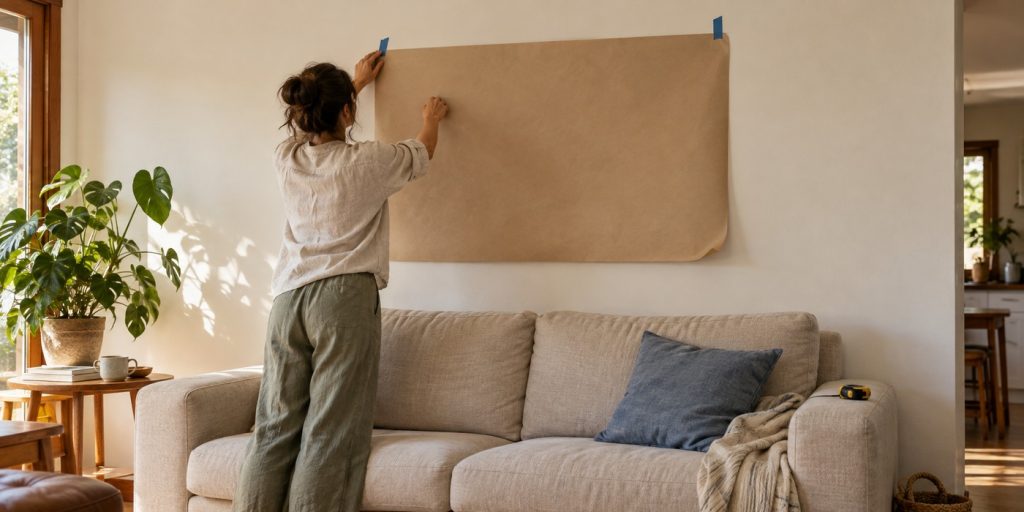
Cut or join paper to the estimated outside dimensions, using a wall-safe temporary method appropriate for your paint finish. Mark which outline you are testing so that an A3 sheet does not quietly become an A3 framed piece in your mind.
Look at it from the doorway and from your usual seat. Does it feel lost? Does it crowd the furniture? Is its position comfortable when you are sitting, as well as when you stand directly in front of it? A photograph taken from your seat can help you compare two tested outlines later, but make the measurements in the room first; a camera angle can distort the apparent size.
Try one alternative size before deciding. A4 and A1 are very different objects, but small differences in position can change the way a room feels too. Move the outline and step back rather than assuming the solution must always be a bigger purchase.
Keep mounting arrangements separate from this planning exercise. The finished frame needs suitable fixings for its weight and the wall construction; ask the framer or an installer if you are unsure. A temporary paper outline does not establish where it is safe to drill.
Choose a subject you want to live with
A living room is a shared space, so ask what the people who use it enjoy looking at. A particular landscape may feel familiar and welcoming. An animal composition may hold interest through shape and pattern. A family photograph may feel right in one home and too private for another.
The Cape Town Collection includes studio-created Ordered Lines artworks of Table Mountain, Lion’s Head and the Twelve Apostles. The African Animals Collection offers wildlife subjects, including the two-zebra composition, with its emphasis on stripes, spacing and contour.
These artworks are developed by the studio and physically drawn in real ink on paper. A real pen makes the lines on the sheet; they are not printed reproductions. You choose the available size of an existing composition, without supplying a photograph or personal title.
If the subject you want is your own family, pet or a particular place, personalised artwork from a photograph is the separate route. The studio interprets your source image and makes the composition decisions after checkout. Look at the examples before choosing between that service and a fixed studio artwork.
Let contrast do some of the work
If you are drawn to black-and-white wall art, consider more than whether the colours match the sofa. Look at the density of the image, the amount of open paper and how strongly its lines read from your usual viewing position.
A detailed image may invite you to move closer. A simpler silhouette may read more immediately across the room. Neither is automatically better. Think about whether you want a work that makes an instant impression or one you will enjoy spending time with at close range.
For a minimalist room, one work with enough space around it may feel settled. If the room already contains patterned textiles and many objects, try the outline in a calmer area before adding another strong visual element.
One piece or a group?
One artwork gives you a single position and frame choice to settle. A group can work well when the subjects have a connection and you enjoy arranging them. You do not need to buy several pieces simply to fill the full width of a sofa.
Measure a group as one complete footprint. For example, three finished frames that are each 40 cm wide, with two 5 cm gaps, need 130 cm in total. Those are illustrative frame measurements, not the dimensions of an Ordered Lines size.
Lay out the arrangement on the floor or use paper outlines before hanging. Consistent spacing and a clear relationship between the pieces can help the group feel intentional, even when not every frame is identical. Allow for the total cost of framing, not just the paper artworks.
Notice the light throughout the day
Watch what happens to the chosen wall in the morning and afternoon. A position that looks shaded when you shop may receive a patch of direct sun later. The Canadian Conservation Institute’s guidance on caring for art on paper explains why light and display conditions deserve attention.
Choose a position away from direct sunlight, sources of damp and excessive heat, and discuss appropriate glazing and mounting with your framer. Reflections matter for everyday enjoyment too: check the view from your seat, not only straight in front of the wall. No frame choice makes an artwork immune to unsuitable conditions.
Know what you are ordering
Ordered Lines artworks are supplied unframed in protective packaging. Framing is a separate choice, which lets you select a finish and mount suited to your room. Check the paper size, the composition’s orientation and the final framing plan before ordering.
If you are choosing a personalised piece for the room, begin with a clear photograph and read how the studio-led process works. If you would prefer an existing subject, explore the studio artwork collections. Choose the subject first, test its scale, and give it a place where you will enjoy seeing it.